Posts tonen met het label Fries Museum. Alle posts tonen

woensdag 24 augustus 2016

Leeuwarden - 3


De reden en het hoogtepunt van mijn bezoek aan Leeuwarden moest de tentoonstelling 'Breien!' in het Fries Museum worden. 

The reason and expected peak of my visit to Leeuwarden should be the exhibition 'Knitting!' in the Fries Museum.


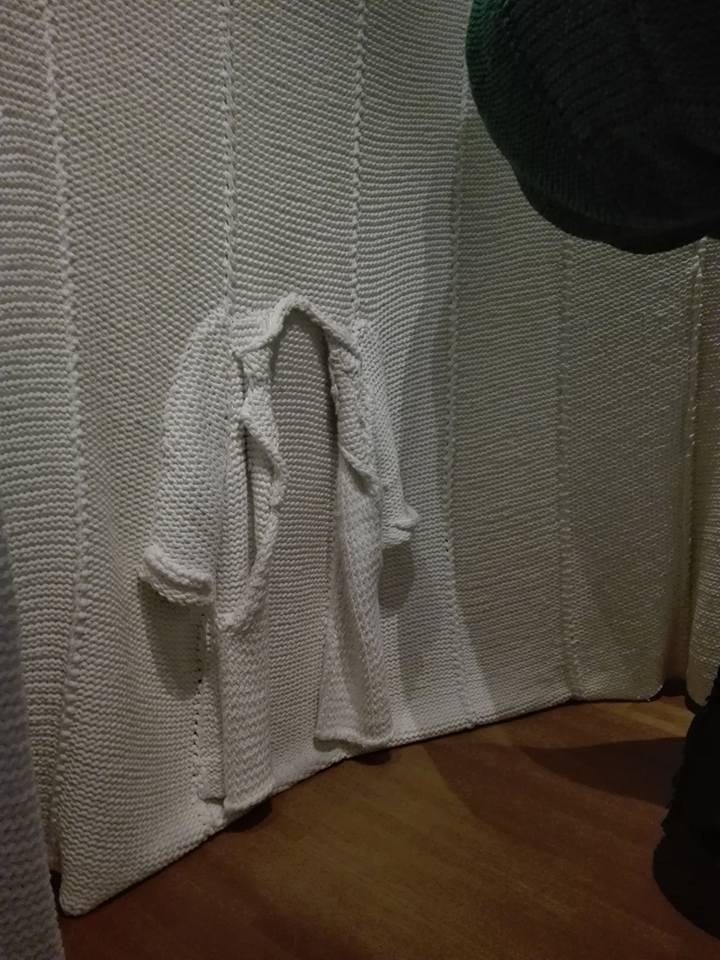
En het was het hoogtepunt! De tentoonstelling toonde de geschiedenis van het breien, hedendaagse toepassingen, moderne breikunst en wat mij het meest deed zwijmelen: oud breiwerk.

And it was a peak! The exhibition showed the history of knitting, contemporary applications, modern knitting art, and what I loved most: the old knitted objects.


De geschiedenis van het breien wordt getoond in kijkkastjes, beginnend rond 1500 tot de hedendaagse toepassingen.
The history of knitting is showed in peepboxes, starting in 1500 up till now.


In het kastje dat voorbeelden van voor en rondom 1500 toont, is er nog geen sprake van echt breiwerk. Wel van naaldbinden, kaartweven en maliewerk in ijzer zoals de ridderhandschoen toont.
 
In the box that shows examples from about and before 1500, we can se examples of needle binding, card weaving and chainmalle. At this stage there is no knitting yet as such.


Nu wordt breiwerk gebruikt voor de meest diverse industriƫle toepassingen. Er wordt gebreid met allerlei kunststoffen en metalen. De breitechniek is praktisch en efficiƫnt: er kan op maat gewerkt worden wat voor minder restafval zorgt. Voorbeelden van toepassingen zijn: kunstgras op een gebreide rug, sportschoenen, vaatprotheses, bouwsteigerdoek en motorpakkingen.
Een immens verschil met wat men in 1500 deed!

At this moment knitting is used for the most diverse industrial applications. All kind of plastics and metals are used for knitwork. The knitting technique is practical and efficiently: custom work is possible, so there is less waste. Examples off applications are: knitted artificial turf, sport shoes, vascular prosthesis, scaffolding cloth and gaskets.
A huge difference to 1500!


Mijn lievelingskijkkastjes waren dat van 1830 en dat van 1920.
My favorite peepboxes were the 1830 box and the 1920 box.


Kralenbreiwerk, ik vind het prachtig. Vooral het beugelbeursje met 9-puntige ster en het tasje met de roze en blauwe bloemetjes stelen mijn hart. Dat bloemetjestasje lijkt me zelfs haalbaar om na te maken...ooit.

In de 19de eeuw kwam dit kralenbreiwerk in de mode. De kralen moesten voor het breien in de juiste volgorde op de draad geregen worden, elke fout was zichtbaar. De objecten waren dan ook luxeproducten door de vele werkuren die er inzaten en de kostbaarheid van de kraaltjes.

Beaded knitting, I love it! Especially the beaded purse with 9-pointed star and the pouch with pink and blue flowers stole my hart. I think it must be possible to knit a little flowerbag as this...

During the 19th century beaded knitting became fashionable. The beads needed to be threaded on the working yarn in the correct order, every mistake would be visible. Therefore these objects were luxury goods because of the many working hours and the expensiveness of the beads.


Floddermutsen werden oorspronkelijk uit kloskant gemaakt. Maar aan het begin van de 20ste eeuw werd het moeilijk om aan de benodigde hoeveelheden kant te geraken. Gebreid kant deed zijn intrede als alternatief. De floddermutsen werden over het oorijzer gedragen. 
Deze floddermuts is toch wel prachtig met die ingebreide bobbeltjes.

Bonnets were originaly made of bobbin lace. But at the beginning of the 20th century it became difficult to obtain the required quantities of it. Knitted lace made its appearance as an alternative. The bonnet was worn over the casque.

Naast de kijkkastjes was er in de andere zalen nog veel meer te zien:
Besides the peepboxes a lot more was to see:

Breiwerk bekend van de televisie - Knitting known from television

 Starsky and Hutch vest
Anna Lund trui


Hunger Games cowl
Prachtige brei-accessoires - Beautiful knitting accessories


Zilveren breidoppen 19de E
Koperen maat 19de E

Breinaaldenhouders 19de E

Boom vol kralentasjes - Tree with beaded purses


Boom vol baby- en slaap mutsjes - Tree with baby hads and night caps 


Het hedendaagse werk - contemporary knitting art


Floating island of pearls - Isabel Berglund

Leaving the nest - Chrystl Rijkeboer
Gebreid met mensenhaar - Knitted with human hair


 City of Stitches - Isabel Berglund

Vindt puberzoon knuffelen maar niets? Dan maak je er een gebreide versie van!
Doesn't your adolescent son like cuddling anymore? Make a knittted version!
Marieke Voorsluijs - Club Geluk


...en nog veel meer. Deze tentoonstelling was voor mij als eten en drinken.
... and much more, this exhibition made me happy as a clam.


maandag 1 augustus 2016

Leeuwarden - 1


De tentoonstelling 'Breien' in het Fries Museum is voor mij een goede aanleiding om een paar dagen in Leeuwarden te vertoeven. Ik zag dat er nog verschillende andere interessante musea zijn en bovendien zijn er ook een paar breiwinkels. 

The exhibition 'Knitting' at the Fries Museum is a good opportunity for me to plan a stay of a few days at Leeuwarden. I saw that there are several other museums and even some yarn shops.


De eerste namiddag gebruik ik om de stad wat te verkennen. Straatje in, straatje uit. Kijken naar gevels en altijd benieuwd wat er achter de volgende hoek zal schuilen. Je moet ook goed naar de grond kijken, want af en toe kom je daar een gedicht tegen. Leeuwarden telt heel wat winkels, restaurants, kleine eethuisjes en aan de rand van de stad coffeeshops.Overal hangt een zoete, wierookachtige geur. Die blijkt van de lindebomen te komen, vreemd, de Leuvense lindebomen hebben een lichtere geur. Misschien staat hier een andere soort?


Arriving in the afternoon, I use the rest of the day to explore the city by strolling the streets. Looking at facades and always curious to what would lay behind the next corner. You even have to watch the ground, because throughout the whole city you find tiles with poemes on them. Leeuwarden has a lot of shops, restaurants, and at the border of town you can find coffeeshops. Everywere you smell - at this time of the year - the incense-like smell of the lime trees. Strange, in Leuven the lime trees have a much lighter smell. Maybe this is another species?


Rondslenterend bedenk ik dat in zo ongeveer in de buurt van Naaicentrum Dekker moet zijn. Met de kaart in de hand vind ik de winkel die ook een ruime collectie breigarens heeft. Op hun site las ik dat ze ook Lopi Einband hebben. Lopi is een Ijslands garen, Einband is het lace garen in de collectie. Ik wil het wel eens proberen, ook al voelt het hard en prikkend aan, de mooie kleuren en de authenticiteit van het garen wil ik in eigen hand voelen. Er zijn prachtige kleuren dus kiezen is moeilijk. Voor de veiligheid kies ik 4 bollen grijs, daar kan ik zeker een sjaal uit breien, met als aanvulling nog 3 kleuren om eventueel in te breien.

Loitering about, I realise that I must be in the neighbourhood of Naaicentrum Dekker. With help of my map I can locate the shop. It has a wide collection of yarns, and on their site I saw that they have Lopi Einband. I've never used this Icelandic lace yarn, so I want to try it. It feels quite rough and prickly, but the beautiful colours and the authenticity of the yarn makes it irresistible. I choose 4 balls of a neutral grey, enough to knit a shawl and complement them with 3 colours so I can eventually add some colourwork.


De volgende dag ga ik met mijn to-dolijst in de hand op stap. Het eerste museum is het Historisch Centrum Leeuwarden, waar ik het ontstaan en de ontwikkeling van Leeuwarden kan volgen. Indrukwekkend hoe enkele eenvoudige nederzettingen zich doorheen de eeuwen ontwikkelen tot een moderne stad.


Next day I went on to town with my to-dolist at hand. First stop is the  Historisch Centrum Leeuwarden, here the history and development of Leeuwarden is shown. Amazing how three small settlements melted together and through centuries became a modern town.


Volgende stop is het  Keramiekmuseum Prinsessehof. Met verbazing kijk ik naar het eeuwenoude porselein en aardewerk. De vakkennis, de kleuren, de motieven, ik word er altijd een beetje sprakeloos van. Het keramiek dat restanten van zeepokken draagt omdat het uit een in gezonken VOC schip komt, doet me wegdromen naar andere tijden. Naar de tijd van maandenlange zeereizen om Nederlandse waar naar de andere kant van de wereld te brengen om terug te keren met allerlei exotische producten. Wat een ondernemingen waren dat voor die tijd.
Op de bovenverdieping stellen twee moderne kunstenaars tentoon. Het kan me niet meteen bekoren, ik voel hier niet het zelfde ontzag als bij de oude collectie. Ik vraag me af hoe mensen hier binnen een paar honderden jaren naar gaan kijken. Maar toch, als ik bij de 3D-kleiprinter sta, ben ik toch wel onder de indruk. Dit is een verfijning van een andere orde dan het Chinese porselein. Oude kennis wordt hier gemengd met nieuwe technologie. Het nieuwe zal nooit helemaal zonder het oude kunnen...

Next stop is The Princessehof National Museum of Ceramics. Speechless I'm watching the age-old ceramics and crockery. The know-how, the colours, the patterns, they amaze me. The ceramic with the barnacles on them because they belonged to the shipload of a sunken VOC ship, takes me away to other times. To the time ships had to sail for months to bring Dutch merchandise to the other end of the world, returning home with exotic goods.
On the top floor two modern artists exhibit their work. I'm not really charmed by it, I don't feel the same awe as for the old collection. I wonder how people will look at this modern art in a few centuries. However, seeing how vazes are made by a 3D-printer I'm impressed. This is something of another order . Old knowledge is mixed with new technology. The new cannot do without the old...


Wordt vervolgd...
To be continued...