zondag 18 september 2016

Summer Shawl


Omdat mijn voorraad echt de spuigaten uitloopt, probeer ik - voorlopig, want ik heb al weer veel mooie nieuwe garens gezien - zoveel mogelijk projecten te breien die passen bij de garens die ik heb liggen.

Because my stash runs out of control, I try - at least for  now, because I've seen already new and beautiful yarns - as much as possible to find projects that suit my stashed yarns.


Vorig jaar kocht ik vier bolletjes Tahiti waar ik 'ooit' wat mee zou doen. Ik val als een blok voor bollen met kleurtjes in. Al zijn de bollen soms mooier dan de projecten: het verloop kan tegenvallen; de kleurcombinatie is soms moeilijk met je kleding te combineren; in driehoeksjaals kan een lang gelijkmatig verloop zorgen voor brede strepen die smaller worden, wat niet altijd mooi is.
 Last year I bought 4 balls Tahiti where I would knit sometime something with. I can't help my love for multi colour yarn. Although sometimes the colour combination looks better on the ball than in a project: the sequence of the colours can be disapointing; the colourcombination can be difficult to combine with your clothes; in triangle shawls broad and smaller bands of colours can be disturbing.


Toch moesten de bolletjes uit de voorraad en zocht ik een patroon. Voor een topje had ik niet genoeg, ik kon maar niet kiezen uit de vele sjaalpatronen die er bestaan. Maar Schachenmayr kwam met de oplossing: zij hebben een patroon voor een sjaal in Tahiti waar je vier bollen voor nodig hebt. 

Nontheless the balls had to be used so I started a search for a pattern. For a top I hadn't enough yarn, but I couldn't make a choice out of the many existing shawl patterns. Schachenmayr themselves came with a solution, they have a patttern especially for Tahiti, and it needed four balls. Couldn't be better!


De sjaal wordt opgezet in het midden van de breedte, zodat hij al meerderend aan de zijkanten en in het midden vanzelf een driehoek vormt. Deze opzet is tot nu toe al de mooiste en de meest onzichtbare die ik voor dergelijke constructie gebruikt heb.

The cast on is in the middle of the width of the shawl, increasing stitches on both sides and alongside the central stich so a triangle is been formed. This cast on is the neatest and most invisible I have done in constructions like this.


Eens het patroon in de vingers ging het breien vlot, maar dat eerste bolletje...dat duurde en duurde. Het garen lijkt eindeloos te zijn en het feit dat er vier bollen in zouden gaan gaf me het idee dat ik maanden over de sjaal zou doen. En er liggen nog zoveel op te breien garens te wachten! Uiteindelijk heb ik van de vierde bol maar 9 gr. nodig gehad. Dus ik vermoed dat een strakke breier of naalden een kwart maat dunner er voor kunnen zorgen dat je maar drie bollen nodig hebt.
 
Once I had the pattern in my fingers the knitting went smoothly. But that first ball, really, that lasted and lasted. There seemed to be an endless lenght of yarn on it. The tought that I would have to knit up four balls gave me the feeling that I would need a lot of time to knit this shawl. But in the end I only needed 9 grs. of the latest one. So I suppose that a tight knitter or smaller needles could manage with three balls.


Intussen heb ik de sjaal al meermaals gedragen. Ongelooflijk hoe een katoenen garen (met 1% polyester) zo licht kan vallen. Ook de grootte is perfect. Ideaal voor de nazomer dus!

Meanwhile I have worn the shawl several times. Unbelievable how light a cotton yarn (+ 1% polyester) can be. Also the measure is perfect. An ideal shawl for an Indian summer.

zondag 4 september 2016

Een dekentje voor Elien - A blanket for Elien


Toen collega Aurélie de komst van haar baby aankondigde kon ik weer gaan snuffelen in alle leuke babydekenpatroontjes.
Moeilijk kiezen is het altijd, er zijn zoveel mooie patronen. Toen ik meer wist over de kleur van de uitzet werd het wat makkelijker om een bijpassend patroon te kiezen.
Het Baby Chalice Blanket-patroon zat al langer in mijn favorieten bij Ravelry. Een eenvoudig en rustig patroon dat het goed zal doen in het grijs. Ik breide het dekentje in Promo Fin van Katia, een zacht acrylgaren dat makkelijk te wassen is en in een mum van tijd droog is. 

Zoete dromen Elien!


When colleague Aurélie announced that she was pregnant, I could start a search trough all the lovely baby blanket patterns.
It's always difficult to choose, there are so many lovely patterns. When I knew the colour of the layette, it became a bit easier.
The Baby Chalice Blanket-pattern was already in my favorites on Ravelry. A simple and calm pattern that will look good in grey. I've knitted it in Promo Fin by Katia, a soft acrylic yarn that is easy to wash and dries in no time.

Sweet dreams Elien!

woensdag 24 augustus 2016

Leeuwarden - 3


De reden en het hoogtepunt van mijn bezoek aan Leeuwarden moest de tentoonstelling 'Breien!' in het Fries Museum worden. 

The reason and expected peak of my visit to Leeuwarden should be the exhibition 'Knitting!' in the Fries Museum.


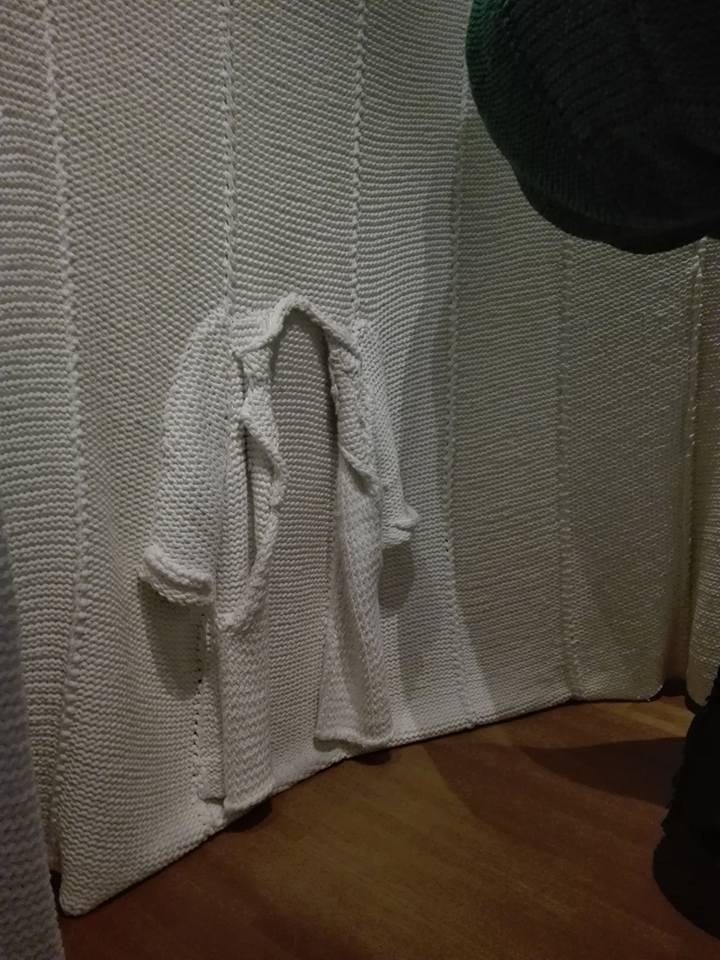
En het was het hoogtepunt! De tentoonstelling toonde de geschiedenis van het breien, hedendaagse toepassingen, moderne breikunst en wat mij het meest deed zwijmelen: oud breiwerk.

And it was a peak! The exhibition showed the history of knitting, contemporary applications, modern knitting art, and what I loved most: the old knitted objects.


De geschiedenis van het breien wordt getoond in kijkkastjes, beginnend rond 1500 tot de hedendaagse toepassingen.
The history of knitting is showed in peepboxes, starting in 1500 up till now.


In het kastje dat voorbeelden van voor en rondom 1500 toont, is er nog geen sprake van echt breiwerk. Wel van naaldbinden, kaartweven en maliewerk in ijzer zoals de ridderhandschoen toont.
 
In the box that shows examples from about and before 1500, we can se examples of needle binding, card weaving and chainmalle. At this stage there is no knitting yet as such.


Nu wordt breiwerk gebruikt voor de meest diverse industriële toepassingen. Er wordt gebreid met allerlei kunststoffen en metalen. De breitechniek is praktisch en efficiënt: er kan op maat gewerkt worden wat voor minder restafval zorgt. Voorbeelden van toepassingen zijn: kunstgras op een gebreide rug, sportschoenen, vaatprotheses, bouwsteigerdoek en motorpakkingen.
Een immens verschil met wat men in 1500 deed!

At this moment knitting is used for the most diverse industrial applications. All kind of plastics and metals are used for knitwork. The knitting technique is practical and efficiently: custom work is possible, so there is less waste. Examples off applications are: knitted artificial turf, sport shoes, vascular prosthesis, scaffolding cloth and gaskets.
A huge difference to 1500!


Mijn lievelingskijkkastjes waren dat van 1830 en dat van 1920.
My favorite peepboxes were the 1830 box and the 1920 box.


Kralenbreiwerk, ik vind het prachtig. Vooral het beugelbeursje met 9-puntige ster en het tasje met de roze en blauwe bloemetjes stelen mijn hart. Dat bloemetjestasje lijkt me zelfs haalbaar om na te maken...ooit.

In de 19de eeuw kwam dit kralenbreiwerk in de mode. De kralen moesten voor het breien in de juiste volgorde op de draad geregen worden, elke fout was zichtbaar. De objecten waren dan ook luxeproducten door de vele werkuren die er inzaten en de kostbaarheid van de kraaltjes.

Beaded knitting, I love it! Especially the beaded purse with 9-pointed star and the pouch with pink and blue flowers stole my hart. I think it must be possible to knit a little flowerbag as this...

During the 19th century beaded knitting became fashionable. The beads needed to be threaded on the working yarn in the correct order, every mistake would be visible. Therefore these objects were luxury goods because of the many working hours and the expensiveness of the beads.


Floddermutsen werden oorspronkelijk uit kloskant gemaakt. Maar aan het begin van de 20ste eeuw werd het moeilijk om aan de benodigde hoeveelheden kant te geraken. Gebreid kant deed zijn intrede als alternatief. De floddermutsen werden over het oorijzer gedragen. 
Deze floddermuts is toch wel prachtig met die ingebreide bobbeltjes.

Bonnets were originaly made of bobbin lace. But at the beginning of the 20th century it became difficult to obtain the required quantities of it. Knitted lace made its appearance as an alternative. The bonnet was worn over the casque.

Naast de kijkkastjes was er in de andere zalen nog veel meer te zien:
Besides the peepboxes a lot more was to see:

Breiwerk bekend van de televisie - Knitting known from television

 Starsky and Hutch vest
Anna Lund trui


Hunger Games cowl
Prachtige brei-accessoires - Beautiful knitting accessories


Zilveren breidoppen 19de E
Koperen maat 19de E

Breinaaldenhouders 19de E

Boom vol kralentasjes - Tree with beaded purses


Boom vol baby- en slaap mutsjes - Tree with baby hads and night caps 


Het hedendaagse werk - contemporary knitting art


Floating island of pearls - Isabel Berglund

Leaving the nest - Chrystl Rijkeboer
Gebreid met mensenhaar - Knitted with human hair


 City of Stitches - Isabel Berglund

Vindt puberzoon knuffelen maar niets? Dan maak je er een gebreide versie van!
Doesn't your adolescent son like cuddling anymore? Make a knittted version!
Marieke Voorsluijs - Club Geluk


...en nog veel meer. Deze tentoonstelling was voor mij als eten en drinken.
... and much more, this exhibition made me happy as a clam.


zondag 14 augustus 2016

Leeuwarden - 2

'Museum Pakhuis Koophandel, 't andere Museum van Oldtimer tot Kant' stond ook op mijn to-dolijstje.

Een museum met een lange naam, waarbij je niet goed weet wat je je daarbij moet voorstellen. Op de site zag ik dat er oldtimers waren en dat er met de na-oorlogse oldtimers rally's georganiseerd worden. Een grootspoor treinbaan en een verzameling rond fotografie, radio's en meccano kan je er ook bezichtigen. Maar wat natuurlijk mijn aandacht trok was de collectie kant en kantklosmateriaal, aangevuld met andere handwerken en naaigerei. Naast deze vaste collecties zijn er regelmatig wisseltentoonstellingen, momenteel loopt de tentoonstelling 'Handwerken uit Peru: het land van Inca's en hun zonnegod'.


'Museum Pakhuis Koophandel, 't andere Museum van Oldtimer tot Kant' was the next museum to visit.
I didn't know how to imagine this museum, so I was very curious to see it for myself. On the website I saw that they have a collection of oldtimers. Also a G-scale train track; a radio, a fotography and a meccano collection is on show. Alongside that, there is a collection about lace starting from the 17th century, and some other needlecraft products and accesories.
Regulary temporary exhibitions are organised. At this moment the exhibition  'Handwerken uit Peru: het land van Inca's en hun zonnegod' is showing


Dat moest ik met eigen ogen gaan aanschouwen. Het museum is gevestigd in het 19de eeuws pakhuis 'Koophandel'. Je stapt dus niet binnen in een traditioneel museum, maar in een echt pakhuis. Je oog valt meteen op de gestalde oldtimers. Ik werd ontvangen door de zoon des huizes die me vertelde wat er allemaal te zien was. 


I had to visit this museum! The museum houses in an 19th century warehouse. So this is not a traditional museum building. When you enter, you really enther a warehouse where the oldtimers are stalled. I was welcomed by the son of the house, he told me how the collections are displayed.


Op de begane grond, voorbij de old timers was er een ruimte met de Peru-tentoonstelling. Mayken Geersing - Domenicus, de bezielster van het handwerkgedeelte van het museum - kwam me wat meer uitleg geven. Deze Peru-tentoonstelling staat niet helemaal los van de oldtimers. Haar man, Marchienes, (de bezieler van de Oldtimer - en andere collecties) nam in 2011/12 deel aan de Pan Americanaroute met zijn Volvo Amazone. Van deze reis bracht hij authentiek en antiek  textiel mee.


Deze kleine tentoonstelling is goed gedocumenteerd. Mayken geeft bij elke kast een korte uitleg en geeft me ook een boekje met de uitgebreide uitleg, zodat ik alles op mijn gemak kan bekijken.


In het Peruviaanse textiel (weefsels, brei- en naaldwerk, borduurtechnieken)  komen veel abstracte motieven en gestileerde mens- en diermotieven voor. Vaak hebben deze een religieuze betekenis. De motieven en technieken van eeuwen geleden worden nog steeds toegepast.


Er is een aparte vitrine voorzien voor 'Atelier Puma', deze organisatie, geleid door Lisette Verkerk en haar Peruviaanse man Octavio, houdt het traditionele handwerk in ere. Van hun eigen alpacawol worden woon- en life style producten gemaakt door Quechua vrouwen. Zij krijgen hiervoor een eerlijk loon waardoor ze de levensomstandigheden van zichzelf en hun familie kunnen verbeteren.


On the groud floor is the temporary Peru-exhibition. Mayken Geersing- Domenicus, the driving force behind the craft section of the museum, tells me more about this exhibition. This particular exhibition is not unrelated to the old timers. Her husband, Marchienes, took part in the Pan Americanaroute in 2011/12 and brought from this trip authentic and old Peruvian textiles.

The exhibition is well documented. Mayken gives me a short explanation at every showcase. She also has a booklet with a more detailed and even extra information.

Peruvian textiles are designed with geometric forms and abstract forms of humans and animals. They often have a religious meaning. Old designs and techniques are used upon today.

Attention is payed to ' Atelier Puma' a project by Lisette Verkerk and her Peruvian husband Octavio. From their own alpaca wool they create house- and life style products. The textiles are woven by Quecha women who are payed a fair earning, so they can improve their living conditions.


Intussen zijn er nog twee bezoekers voor het museum gearriveerd, Mayken geeft ons boven bij de vaste collectie uitleg. De collectie kant- en kantklosmateriaal omspant enkele honderden jaren. Mayken vertelt dat de kantklostechniek rond 1600 tegelijkertijd ontstond in Italië en Vlaanderen. Ook Leeuwarden kent in de 17de en 18de een kantindustrie. De belangrijkste opdrachtgever voor kantwerk was de hofhouding van de Friese stadhouders.Nu is het kantklossen meer een kunststroom dan een nijverheid.                                                                                                                 
Meanwhile two other visitors have arrived. Mayken gives us an explanation about the lace collection. This collection spans several centuries. Mayken tells us that the lace making technique was developed around 1600 simultaniously in Italy and Flanders. Leeuwarden also had a lace industry during the 17th and 18th century. The main commissioner was the court of the stadtholder, the lace industry went down after the court moved to Den Haag. Nowadays lace making is more a trend in art.


Naast de kantcollectie zijn er nog enkele antieke merk- en stoplappen vanaf 1694 te zien. Ook is er schoolbreiwerk en antiek naaigerei te zien.
Ook over deze collectie wordt extra uitleg gegeven in een bundel, maar omdat het stikheet was op deze zolderverdieping heb ik vooral mijn ogen de kost gegeven.


Besides the lace collection, embroidery- and darning samples are displayed. Also some school knitting work and sewing accesories are shown.
Also for this collection a booklet with extra information is available. But it was so hot on the day I visited the museum and since the lace collection is on the attic floor I mainly looked and took pictures.


Ik heb echt genoten van dit verrassend museum, het is een aanrader. Ik hou zeker de volgende wisselcollecties in het oog...

I really enjoyed this museum and recommend it to all crafters. I keep an eye on the forthcoming exhibitions...