zondag 6 september 2015

Breitreinsokken - Knitting train socks


Een breitrein? Ja echt, een breitrein! Met 27 breisters vertrokken we - lekker gezeten op onze gereserveerde plaatsen - vanuit Leuven naar Blankenberge. Op een rit van 2 uur kan je heel wat afkletsen en breien.


A knitting train? Yes, a knitting train! With 27 knitters we set off - seated on our booked seats - from Leuven to Blankenberge. On a 2 hours drive you kan chatter en knit a lot.


Ik nam een eenvoudig sokkenbreiwerk mee, ik weet hoe dat gaat met kletsen en breien! Uit de sokkenwoldoos koos ik een garen dat vraagt om een simpele steek. Het Olé Socks India garen van Katia heeft prachtige kleurcombinaties. Een 3/1 boordsteek is voldoende voor dit garen.

 
I took an easy knitwork with me, I know how it goes to knit while chatting! From my sock yarn box I choose Olé Socks India by Katia, I love the colours of that range. It's a yarn that works well in a simple stitch. I used a 3/1 rib.


In Blankenberge genoten we samen van een lekkere lunch en gingen daarna snel verder breien op een zonnig terras. Daarna keerden we weer - al breiend - huiswaarts op onze gereserveerde plekjes.


In Blankenberge we enjoyed lunch and went on knitting on a sunny terrace. After that we returned home by train, again whilst knitting on our booked seats. 


Een super geslaagde dag, met veel tevreden madammen die elkaar leerden kennen, veel gelach en geklets: Dankjewel voor de organisatie Gerda! We kijken al uit naar volgend jaar!


It was a super succesful day, with a lot of content ladies who get to know each other, a lot of laughing and chatter: thank yo Gerda, for organizing this day! We are already looking forward to next year.


Ook bij Rita kan je over deze dag een verslagje vinden.

On Rita's blog you can also find a report of this day.


woensdag 2 september 2015

Priegelblog on Facebook

Priegelblog on Facebook, my creative day-to-day life in little messages:

https://www.facebook.com/priegelblog

zondag 23 augustus 2015

Patchworksokken - Patchwork socks

In het boekje 'Breien to go: Sokken', ben ik toe aan het gedeelte waar er kleurtjes aan te pas komen.
Voor de patchworksokken koos ik paars angora merino sokkengaren van Regia. Daarbij paste Heather van Kaffe Fasset perfect...dacht ik.

In the booklet 'Knitting to go: socks' I reached the part where colourwork is applied.
For the patchwork socks I choose angora merina sock yarn by Regia in plum colour. Heather by Kaffe Fasset went perfect with the plum...so I tought.


Ik had het dus fout. Het kleurverloop is te kort en er komen paarse tinten in de Heather waardoor het stekenpatroon verloren ging.

I was wrong there. The colour pattern repeat is too short and contains purple shades which made disappear the stitchpattern.

Ik vond nog een restje Super Soxx Color dat ik dan maar gebruikte. Een heel ander kleurpatroon dan ik voor ogen had en ook niet echt mijn kleuren, maar het werkte wel.

I found some leftover Super Soxx Color to use. A complete different colour pattern than I had in mind, and not really my colours. But it worked for the stitchpattern.


vrijdag 7 augustus 2015

Flore's dekentje - Flore's blanket

Als er een zwangerschap aangekondigd wordt, flitsen er meteen allerlei patroontjes door mijn hoofd. Dat was niet anders toen Sofie vertelde dat ze zwanger was. Ik vroeg haar meteen naar haar wensen wat kleur betrof. Ze toonde me een foto van de uitzet die ze zou kiezen, maar eigenlijk was het gelijk. Zolang het maar geen roze was mocht de baby een meisje zijn.


When a pregnancy is announced, patterns are flashing through my mind. It was no different when Sofie announced her pregnancy. I asked her about her preferences in colour and she showed me a picture of the bedding theme she had chosen. But in fact she would be happy with anything, as long it wouldn't be pink if the baby should be a girl.
 
Ik had meteen een idee, ik had op Ravelry al een patroon van een dekentje aangestipt met slipped stitches. Dat paste prima met het motiefje van de uitzet vond ik. En was bovendien een unisex dekentje, mocht de baby een meisje worden kon ik voor de boord nog iets 'frullerigs' verzinnen.

On Ravelry I saw a pattern with slipped stitches which would go along well with the motif of the bedlinnen. It was also quite unisex, and if the baby would be a girl I could add a more frilly border.

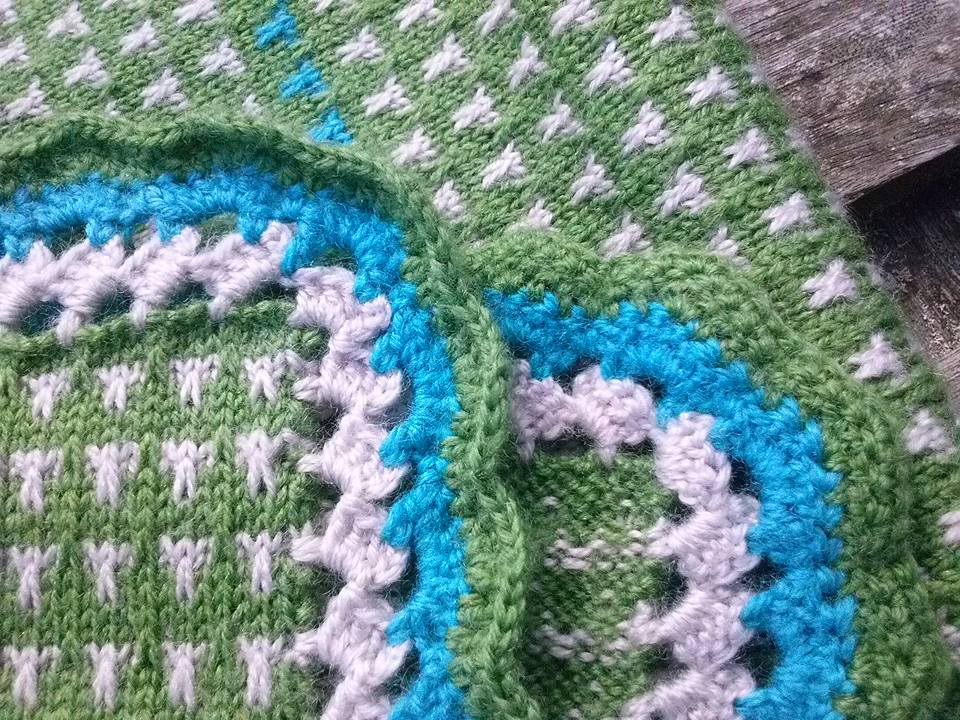
Ik sloeg een voorraad kleuren van Katia Promo Fin in waarvan ik dacht dat ze bij de uitzet zouden passen en ging met proeflapjes aan de slag. Aanvankelijk volgde ik het principe van het patroon, daar word in elke nieuwe baan de voorgaande accentkleur hoofdkleur. Leuk om zo te spelen met kleurtjes en te zien hoe sommige kleuren lijken te veranderen in combinatie met een andere kleur. Anderzijds: ik en kleuren...ik vind het iets moeilijk, en ik bleef me vastpinnen op de kleuren van de uitzet. Dus ik speelde op heel veilig en koos gewoon de kleuren van de uitzet: groene achtergrond met ecru als accentkleur, waarbij het ecru elke 11de accentrij werd vervangen door blauw. (In de uitzet zit een piepklein blauw ruitje tussen de ecru 'dingetjes'.)
Als extra eigen ideetje breide ik de averechtse steken in het patroon ook gewoon rechts, waardoor het dekentje gladder en 'rustiger' werd.


I stocked up different colours of Katia Promo Fin and started making swatches. At first I followed the principle of the pattern: in every new bar the accent colour of the former bar becomes the head colour. Nice to play with colours and to see how they seem to change in combination with another colour. On the other hand: me and colours...I find it quite difficult. So I kept it safe and chose the colours of the bedlinen: a green background with ecru as accent colour, changed with blue after 11 repeats. (In between the ecru 'thingies' on the bedlinen sits a tiny blue check.)
As an own idea I left out the purled stitches, it gives the blanket a smoother appereance.


Toen het dekentje af was sloeg de schrik me wel even om het hart. Het krulde wel heel erg, en door redelijk vast te breien trok het door de slipped stitches in de breedte toch wel erg samen. Dat had ik me tijdens het breien al een paar keer bedacht, maar had mezelf telkens gesust met: komt wel goed!

When de blanket was finished I was seazed with fear: the edges curled really badly and because of the slipped stitches and tightly knitting it lacked drape. I noticed this while knitting, but thought it would turn out well in the end.

Misschien zou dat beter worden als er een boord aanzat. Intussen wist ik dat de baby een meisje zou worden dus mocht die 'frullerig' worden. Ik wou beginnen met een rij vasten als basis, maar het lukt me maar niet om een nette en egale rij rond het dekentje te krijgen.
Paniek!!! Geprobeerd met halve vasten en lossen tussenin, dat leek er al iets meer op, maar was het nog niet helemaal. Toen herinnerde ik me iets van 'schuine blokjes' (block edging heet dat in het net) , die je ook in volgende rijen kon herhalen. Misschien was dat wat? Al stapte ik dan wel af van het 'frullerige' idee.


Maybe it would be better after I crocheted the border. In the meantime I knew the baby would be a girl, so ik could go for 'frilly'.  I started with a row single crochet stitches, but it really didn't want to work, I couldn't get it neat and even. I started panicking there! I tried halve crochet stitches with in between chain stitches, that looked better but not quite as I want it. Then I remembered something with 'slanting blocks' ( block edging it is called  ;-)), which can be repeated in following rows. Maybe that would work, altough I would left the idea 'frilly'.


De eerste rij zag er netjes uit, maar de volgende rij vond ik maar niks. Meerdere blokjes-rijen pasten gewoon niet bij het dekentje. Dan maar op zoek wat ik verder kon doen met de blokjes als basisrij. Met wat trial and error lukte het me om tot boogjes en dus toch tot wat 'frullerig' te komen.


The first row looked neat, but I didn't like a next row of it. More block edging rows didn't fit with the blanket. Again I started searching and trying what to to as a second row. With some trial and error I came to scallops and so the 'frilly' part was back!


Maar het krullen en samentrekken bleef... Zou ik dat kunnen opheffen door nat te blocken? En bleef dat dan of zou het na elke wasbeurt weer gaan krullen? Ik ging op Internet op zoek naar het blocken van acryl. Nat blocken heeft geen blijvend effect bij acryl, steam blocking wel. Er bestaat wat controverse rond, sommige sites raden het steam blocken af bij acryl omdat het het breisel 'doodt', of dat het breisel slap wordt . Maar 'killed acrilyc' en steam blocked acrilyc is toch nog wat anders zegt Deja Jetmir. Ik besloot haar te geloven en een proeflapje te steam blocken. Eng wel, een stomend heet strijkijzer boven een synthetisch garen...maar het werkte echt wel! Niks gesmolten, lapje mooi glad en zacht en inderdaad wat slapper dan voor het geblockt werd.
Als test blockte ik een ander proeflapje gewoon nat. Dat werd ook wat gladder, maar niet zo strak als het steam blocked lapje. Als ultieme test waste ik beide proeflapjes en liet ze plat drogen. Het steam blocked lapje droogde mooi glad op, het nat geblokte lapje ging weer krullen

 
But the curling and the lack of drape remained. Would I be able to fix that with some wet blocking? And would the blocking result survive washing? I did a search on blocking acryl knitwork. Wet blocking has no lasting effect on acryl, but steam blocking has. There is some controverse about it, some sites advise against it because it kills the knitwork, although it can ad more draping. Deja Jetmir explains clearly the difference between 'killed acrilyc' en steam blocked acrylic. I believed her and wanted to give it a try on a swatch. A bit scary though, a steaming hot iron above synthetic yarn...but it really worked!!! Nothing melted, a soft, drapy and smooth swatch was the result.
I did some wet blocking on another swatch, that hadn't such a smooth result. As an ultimate test, I washed both swatches and let them dry flat. The steam blocked swatch remained flat and smooth, as the wet block swatch curled again.


Na de wasbeurt: 1. niet geblocked, 2. wet blocked, 3. steam blocked
After washing: 1. not blocked at all, 2. wet blocked, 3. steam blocked


Met klamme handjes besloot ik het dekentje te steam blocken. In het allerergste geval zou ik een nieuw dekentje moeten breien. Maar het is gelukt. En hoe! Het dekentje is mooi in vorm en voelt zacht aan. Het voelt ook helemaal niet te slap aan, waarschijnlijk omdat het redelijk vast gebreid werd. Dus voor dit project was het steam blocken echt een zegen!


With sweaty palms I decided to steam block the blanket. The worst case scenario would be that I had to knit a new blanket. But it worked. And how! The blanket is now nicely flat en feels softer. And above all: it has a nice drape. So for this project steam blocking was really a blessing!!


woensdag 22 juli 2015

Sokken met een kabelboord - Cabled Top Socks

The Ultimate Sock Book van Vogue Knitting: een heerlijk boek voor sokken breisters. Naast de geschiedenis van het sokkenbreien krijg je de basistechnieken en de anatomie van de sok uitgelegd. Met tips over garen, een sock-calculator, een basispatroon en tal van fantasiesteken ontwerp je je eigen sok. Bovendien staan er ook 25 uitgewerkte patronen in het boek.

The Ultimate Sock Book by Vogue knitting: a gorgeous book for sock knitters. Besides the history of sock knitting you get the basic techniques and the anatomy of a sock explained. With tips on yarn, a sock calculator, a basic pattern and a lot of fantasy stitches you can design your own pair of socks. Futhermore there are 25 patterns in detail in the book.


Ik wil het boek netjes uitbreien en begon met het eerste patroon. Niet echt mijn favoriet: een sok zonder hiel...

I want to knit all those 25 patterns and started neatly with the first pattern. Not really my favorite: a tube sock with no heel shaping...


Maar alles moet een keer geprobeerd worden en bij elk patroon leer je wel iets nieuws denk ik dan maar.

But everything needs to be tried and with every pattern you can learn something new, so I think.


De boord van de sok bestaat uit een I-cord - voila, daar heb je het nieuwe al! - tot een ketting gehaakt. Langs die ketting neem je de steken voor het been op. En dan is het, hupakee, gewoon doorbreien tot aan de teen. Het spiraalpatroon zou er voor zorgen dat de sok, bij gebrek aan een hiel, toch op zijn plaats blijft en niet rond de voet gaat draaien.

The border of the sock consists of an I-cord - that's already a new thing to me! - crocheted to a chain. Along that chain you pick up the stitches for the leg. And then it is, easy peasy, knitting up to the toe. The spiral pattern should help to avoid the sock, due to absence of a heel, winding around the foot. 


De teen is een sterteen waarbij de overblijvende steken worden samengetrokken en vastgezet. Ook deze teen is niet mijn favoriet, ik brei gewoonlijk een 'wedge toe' die ik dicht maas. Maar ik deed het netjes volgens het boek, bij een eerste patroon doe ik dat nog wel.

The toe is a star toe and the remaining stitches are pulled together and secured. Not my favorite, I usually knit a wedge toe and graft it. But I did everything by the book, I'm still obedient for now.


Omdat ik niet zo'n fan was van het patroon gebruikte ik een sokkengaren met een kleurverloop waar ik ook niet zo gek van was. Maar toch is het wel een leuk paar sokken geworden en tijdens het breien deden de kleuren me steeds maar denken aan het driekleurig ijsje van 'vroeger'. Dat ijsje blijkt trouwens een Expo-ijsje te heten, en werd ter gelegenheid van Expo 58 ontwikkeld. De drie kleuren zouden met wat fantasie voor de kleuren van de Belgische vlag staan. Weer wat geleerd...

Since I wasn't in favour of the pattern, I used a sock yarn which colours I didn't like that much either. But it became a nice pair of socks. And while knitting, the colours reminded me of the tri-color ice cream from years ago. Looking it up for a picture of it, I found out that it's called an Expo-icecream, because it was developed especially for the Expo of 58 in Brussels. De three colours should, with some fantasy, refer to the colours of the Belgian flag. Again learned something...


zondag 28 juni 2015

Top down topje

Vorig jaar kocht ik in 't Wolwinkeltje de laatste 4 strengen Rowan Summer Tweed in de kleur Denim. 200 gr, een topje zou ik er wel uitkrijgen.

Last year I bought at 't Wolwinkeltje the final 4 hanks of Rowan Summer Tweed in Denim color. 200 grs, a top should be possible.


Om een geschikt patroon te vinden is Ravelry mijn grote vriend. Je kan er zoeken op garen en dan zien welke patronen met dit garen gemaakt zijn. Ik vond er de Bernat Leaf Top-versie van Penny. Zij breide de top met vier strengen, als dat bij haar lukte moest mij dat ook lukken. Voor de zekerheid koos ik voor maat XS, desnoods zou ik mijn adem wel wat inhouden  ;-)

To find a suitable pattern Ravelry is my best friend. You can search by yarn and see the projects made with it. I found the Bernat Leaf Top-version by Penny. She used only 4 hanks, so I should be able to do the same. To be sure I chosed size XS, if needed I would pull my belly in to made it fit ;-)


En ja hoor, het is gelukt! Ik denk niet dat ik nog veel meer dan 1 meter garen over heb. En ik moet mijn adem niet inhouden, het topje past perfect en zit lekker.

And yes, I did it! I don't have much more than 1meter yarn left. But above all I don't need to pull my belly in. The top fits well and feels comfortable.

zondag 7 juni 2015

Over schriftjes - About (paper!) notebooks


Schriftjes, daar heb ik wat mee. Ik ga er steeds naar op zoek als ik een zaak met papierwaren passeer. Het zijn hebbedingen die budgettair verantwoordt zijn en bovendien worden ze nuttig gebruikt. Bij elk breiproject zit een schriftje waarin alles minutieus wordt genoteerd. Het lijkt soms geheimschrift en ja, het gebeurt dat ik het zelf niet helemaal meer kan ontcijferen…


Notebooks, I love them. When I pass a stationer’s shop I can’t resist to go in and look for them. They are must haves within budgetary limits and above all they are useful.
Every knitting project is accompanied by a notebook in which I take meticulous notes. Often it looks as secret writing, so yes, it happens that I have difficulties to decipher it myself.

  
Mijn voorkeur gaat uit naar schriftjes in A7 formaat, graag met een romantisch bloemig kaft. Soms is zelfs ook de binnenkaft mooi bedrukt. Gewoon bruin vind ik ook wel mooi en robust. A6-jes en A5-jes kunnen overigens ook hoor.


I prefer my notebooks in a handy A7 size,  although I stock A6 and A5 sizes as well. The cover is preferably a romantic floral design, although a sober brown notebook attracts me to, they look so robust.


Als een schriftje vol is ga ik het ontleden, want het bevat een schat aan informatie. Relevante info over het breiwerk wordt toegevoegd aan het betreffende project op Ravelry. Maar vooral de niet brei-gerelateerde info is geweldig om te herlezen.


When a notebook is full I need to analyse it, because it contains a wealth of information. Relevant information about the knitting projects is added to Ravelry.  But particulary the not-knitting related information is awesome to reread.


Als ik brei kijk ik vaak televisie, ik zorg dat de digibox vol programma’s zit naar mijn zin. Meestal documentaires, maar tuinprogramma’s en af en toe een film komen er ook in. Als ik ‘live’ tv kijk blijf ik vaak wel eens hangen bij een kookprogramma. En dan is zo’n schriftje erg handig om bij de hand te hebben en er iets in te kriebelen, wat ooit opgezocht, gelezen of gemaakt kan worden.


When knitting I often watch TV, so I make sure that my digibox is full of programs to my desire. Mostly documentaries, but also gardening programmes and now and than a good movie are added. When I watch live television I linger often with coocking programmes. Having a notebook by hand is always easy to jot down something that needs to be looked up, read or made sometime.


Zo toonde een gedreven Ionica Smeets (het wiskundemeisje) in een uitzending van Zomergasten het You Tube-filmpje over het wiskundig onmogelijke ananashuis van Sponge Bob. Haar soort wiskunde is leuk, dus dat filmpje en nog meer moest een keer herbekeken worden. Genoteerd!

I saw a very driven Ionica Smeets (the maths girl) in an episode of ‘Zomergasten’ telling about a You Tube clip about the mathematical impossibility of the pine apple-home of Sponge Bob. Her way of looking at maths is fun, this clip and others needed to be reviewed so I took note of it.


Ook boeken maken een groot aandeel uit van de notities met dank aan Wim Brands.
In het schriftje dat ik momenteel ontleed vind ik ook: ‘Soda bread (moet niet rijzen’. En paar bladzijden en projecten verder: ‘scones met kaas (bakpoeder) Nigel Slater’. 

Thanks to Wim Brands book titles take a great part of my aded notes.
In the notebook I currently dissect I also find: ‘soda bread (doesn’t need to rise)’ and 'cheese scones – Nigel Slater’.  Still need to give these a try…


Maar soms komen er warempel handwerkgerelateerde wetenswaardigheden op tv. In een uitzending van ‘De Ijzeren Eeuw’ zei Hans Goedkoop, kijkend naar een portret van Johanna Borski : 'het lijkt wel een oude breisok!' Erg vleiend klonk het niet, dus ik was benieuwd naar de exacte betekenis van die uitdrukking. 
Een breikous zou een vrouw zijn die weinig zegt, maar ook gewoon een kous die nog op de naalden staat…

But sometimes there are actually needlework related facts on TV.  In an episode of Ijzeren Eeuw  I heard Hans Goedkoop – looking at a painting of Johanna Borski - saying: 'She looks as an old knitting sock!' It didn’t sound very flattering, so I was curiuous about the meaning of being a knitting sock.
A knitting sock would refer to a woman who doesn't say much, but it is also a sock still on the needles...


In een andere aflevering van ‘De Ijzeren Eeuw’ ging het over de activiteiten van dames uit de hogere klasse. Veel meer te doen dan hun huishouden te besturen hadden ze niet. Ze waren te chique om te werken, en hun sociale omgang moest aan een bepaalde standaard voldoen. Dat bracht Betsy Perk op het idee om ‘Arbeid Adelt’ op te richten, waar dames van stand hun handwerk konden verkopen en zo economische zelfstandigheid te verwerven. De organisatie bestaat nog steeds.

Another episode of ‘De Ijzeren Eeuw’ told us about the activities of women of the upper class. They hadn’t much more to do than to run their household. They were to posh to work en their social contacts needed to be upon standard. That brought Betsy Perk to the idea to establish ‘Arbeid Adelt’, an organisation where women of the upper class could gather en sell their needlework. Which also gave them the opportunity to become more economical independent. The organisation still exists today.


Om maar te zeggen dat handwerken verre van een nutteloze bezigheid is…

Just to say that needlework is far from idle…